Showing posts with label Gerry Adams. Show all posts

Thursday, March 19, 2015

Ireland: Sinn Féin fights welfare attacks in the north

Sinn Féin MLA and Deputy First Minister Martin McGuinness
On Monday March 9, Sinn Féin announced it would oppose the new welfare reform bill in the northern Irish Assembly, accusing its government partners – the Democratic Unionist Party (DUP) – of acting in bad faith on protecting welfare recipients.

Sinn Féin is in a power-sharing arrangement as part of the Good Friday peace agreement signed in 1998, which sought to end the violence that had wracked Ireland's north since the late 1960s, known as The Troubles.

The same day, Sinn Féin moved a Petition of Concern — supported by the Social Democratic and Labour Party (SDLP) — in the Assembly to prevent the passage of the bill, which would impose cuts to welfare. This forced the DUP Minister for Social Development, Mervyn Storey, to withdraw the bill and re-enter talks to resolve the stand-off.

The welfare reform bill forms part of the recent Stormont House Agreement (SHA) – a five party agreement covering national identity issues, welfare reform and government finance in northern Ireland that was agreed to on December 23 last year, after several months of fraught negotiations.

Throughout last year, disagreements between Sinn Féin and the DUP on a range of issues escalated dangerously, and there was growing risk that failure to arrive at an agreement on the SHA might bring down the Stormont administration.

Wednesday, December 10, 2014

Irish water protesters bring Dublin to a standstill

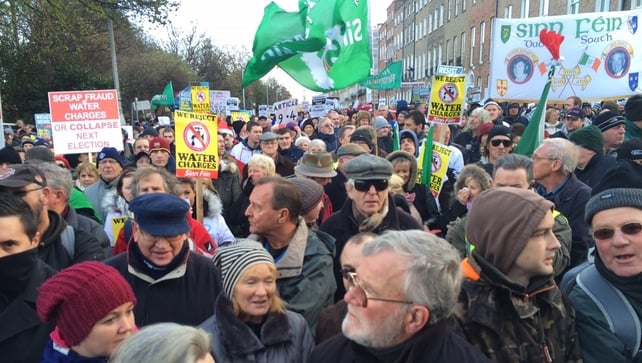
Up to 100,000 protesters shut down Dublin city on December 10 in the latest mass demonstration against the introduction of water charges.

Protesters from across the country braved media hysteria, riot police and police barricades, and the threat of a fierce storm to descend on the centre of Dublin, placing Leinster House – home of the Dáil (Irish parliament) – and other government buildings in “lockdown”.

The protest – organised by the Right2Water campaign – was the third major protest against the charges in two months, following on from a 100,000 strong march in Dublin on 11 October and protests across Ireland on 1 November that attracted around 200,000 in dozens of towns and cities.

The introduction of new charges on water use, levied via new state-owned company Irish Water, has brought years of anger with austerity cuts and government arrogance to a head.

Not only is the cost of water already covered by general taxation, however, but it is also widely believed that water charges are only the first step towards the privatisation of Irish Water and water charges.

Tuesday, November 18, 2014

Ireland: Government drowning between water revolt and a rising Sinn Féin

Faced with a growing public revolt against the introduction of water charges and a faltering support, the Irish government is in a deepening crisis.

The government — a coalition between the right-wing Fine Gael party and the Irish Labour Party — came to power in 2011 on the back of public outrage over austerity and social spending cuts.

The impact from the global financial crisis hit Ireland particularly hard. According to Eurostat, Ireland has paid 42 percent of the total cost of the European banking crisis, or 41 billion euros — about 9000 euros per person. The average across the European Union is 192 euros per person.

The government of Fine Gael Taoiseach (prime minister) Enda Kenny is presiding over further austerity cuts at the behest of the International Monetary Fund (IMF) and the European Central Bank (ECB). The unemployment rate, however, remains well into double figures, and wages are low.

Despite the scale of Ireland’s economic collapse, social unrest has remained minimal. Instead, Ireland — with a population of only 4.5 million — has witnessed a more literal decimation. More than 400,000 people, mostly young people, skilled workers and families, have emigrated in search of work and a better lifestyle.

Friday, March 4, 2011

Ireland: Ruling party crushed, left gains in poll


On February 25, Ireland’s governing party, Fianna Fáil, and its coalition partner the Green Party, were massacred in a general election revolt.

The most successful establishment party in Western Europe for the past 80 years, Fianna Fáil were demolished – reduced from 77 to only 20 seats on the back of public outrage over austerity measures and social spending cuts.

In Dublin, Fianna Fáil was reduced from 19 seats to one.

The Greens - its partners in political crime - were wiped out entirely, failing to win a single seat in Dáil Éireann (Ireland’s parliament) and winning less than 2% of the vote.

Voters punished the government for its handling of the global financial crisis, which saw Fianna Fáil bankrupt the country by bailing out Ireland’s major banks to the tune of €45 billion.

To get out of the financial black hole - and 13.6% unemployment - it had created, the government then pawned the country for as much as €100 billion in financial loans from the European Union (EU) and International Monetary Fund (IMF).

The austerity measures demanded by the IMF and EU agreement will result in 30,000 public sector jobs being cut and social spending reduced for years to come.

Tuesday, March 1, 2011

Bobby Sands: 30 years on hunger strike - never defeated.

On March 1, 1981, Irish Republican political prisoner Roibeárd Gearóid Ó Seachnasaigh - known to all the world as Bobby Sands - went on hunger strike in Britain's "H-Block" prison cells of Long Kesh prison.

He went on hunger strike after he and fellow Republican prisoners had gone on a failed "blanket strike" - refusing to wear prison uniforms - as a protest against Britain's refusal to recognise their status as political prisoners in the struggle for Irish freedom.

In 1978, after a number of them were attacked leaving their cells to empty their chamber pots, their protest escalated into a "dirty protest" - the prisoners refused to wash and smeared the walls of their cells with excrement.

When that strategy too failed to budge the Brits, some among the "blanket men" decided to raise the stakes for political recognition, and volunteered for hunger strike.

The first hunger strike - in late 1980 - won the promise of recognition. However, when Britain refused to carry through its promises, a new coordinated effort began with Bobby Sands on March 1, 1981.

Sands - despite being elected to British parliament from his prison cell - was allowed to starve to death, without his demands being met, the Thatcher government refusing to compromise.

Sands' hunger strike lasted 66 days before - wasted and starved - his body collapsed.

He was followed into the darkness by Patsy O'Hara, Francis Hughes, Ray McCreesh, Kiernan Doherty, Kevin Lynch, Joe McDonnell, Martin Hurson and Mickie Devine.

In all, ten men dead.

Bobby Sands himself was born in March, 1954, into a poor, working-class family in Newtownabbey, a Unionist area of Belfast. When the neighbours discovered that his family was both Catholic and Nationalist, they were intimidated, harassed, and driven out.

He endured sectarian violence - including stabbings - and losing his apprenticeship at gunpoint, before joining the Irish Republican Army (IRA) in 1972.

That same autumn he was picked up by the police and tortured - a common police practice - before he was sentenced to five years in the Long Kesh concentration camp.

While in prison, he became a strong and disciplined Republican, facilitating the teaching of Irish. While there he established what came to be known as the Long Kesh "Gaeltacht" (Irish-speaking area).

After three and a half years he was released, returned to the IRA, married, had a son, and became deeply involved in social justice issues in his local community, before being arrested again in 1976, tortured, beaten and sentenced - with 5 friends - on flimsy evidence to 14 years in Long Kesh for supposedly having a gun under the back seat of a car.

Throughout his adult life Bobby Sands endured pain and suffering. Yet these same years of pain, filth and stench saw him bloom as a poet, musician and author, and he became the spokesperson and negotiator for his fellow prisoners in their struggle for dignity and recognition.

Bobby wrote, "I refuse to change to suit people who oppress, torture and imprison me. They have suppressed my body and attacked my dignity, but I have the spirit of freedom that cannot be quenched by even the most horrendous treatment. Of course I can be murdered, but while I remain alive I remain what I am - a political prisoner."

Sands kept a diary during the early stages of his hunger strike. The final entry was made - in Irish - on only March 17.

“Mura bhfuil siad in inmhe an fonn saoirse a scriosadh, ní bheadh siad in inmhe tú féin a bhriseadh. Ní bhrisfidh siad mé mar tá an fonn saoirse, agus saoirse mhuintir na hEireann i mo chroí. Tiocfaidh lá éigin nuair a bheidh an fonn saoirse seo le taispeáint ag daoine go léir na hEireann ansin tchífidh muid éirí na gealaí.”

Translated, it reads:

"If they aren't able to destroy the desire for freedom, they won't break you. They won't break me because the desire for freedom, and the freedom of the Irish people, is in my heart. The day will come when all the people of Ireland will have the desire for freedom to show. It is then we'll see the rising of the moon."

At the end of March, Frank Maguire, the independent MP for Fermanagh-South Tyrone died of sudden heart-attack. Sinn Fein decided to run Bobby Sands as a candidate.

Sands won with 30,492 votes, humiliating the British.

Still Thatcher and Britain wouldn't yield. Instead, they passed a law preventing prisoners from running for election.

Finally, on May 5, 1981, Bobby Sands, one of the greatest Irish people of the Twentieth - or any other - century, died in the Hospital Wing of Long Kesh prison.

On May 7, 100,000 people marched silently behind the coffin and nearly as many more lined the streets. The funeral of Bobby Sands MP was the largest in Ireland since that of Parnell.As Gerry Adams remarked of Sands' election to parliament, "His victory exposed the lie that the hunger strikers - and by extension the IRA and the whole republican movement - had no popular support".

Following Sands' death, Iran renamed the street on which the British Embassy was located after him, the Indian parliament held a minute's silence, and Cuba later erected a monument to all 100 hunger strikers, which was unveiled by Gerry Adams and Fidel Castro.

Bobby Sands became a symbol internationally of the Irish struggle for freedom and independence, and stands as a reminder that Imperialism cannot be parleyed with or trusted, but must be defeated at every turn, in every heart and every mind.

Thirty years on, Bobby Sands' words still echo down the years, reminding us of the victory that we seek, from Belfast to Beirut, from Derry to Dili, from Armagh to Asunción. Not a violent, vengeful future, but a future where all of humanity can live in peace and happiness, in freedom and in equality.

"Let our revenge be the laughter of our children".

Tiocfaidh ár lá!